POLAND'S COURT WAR REACHES THE TRIBUNAL DOOR
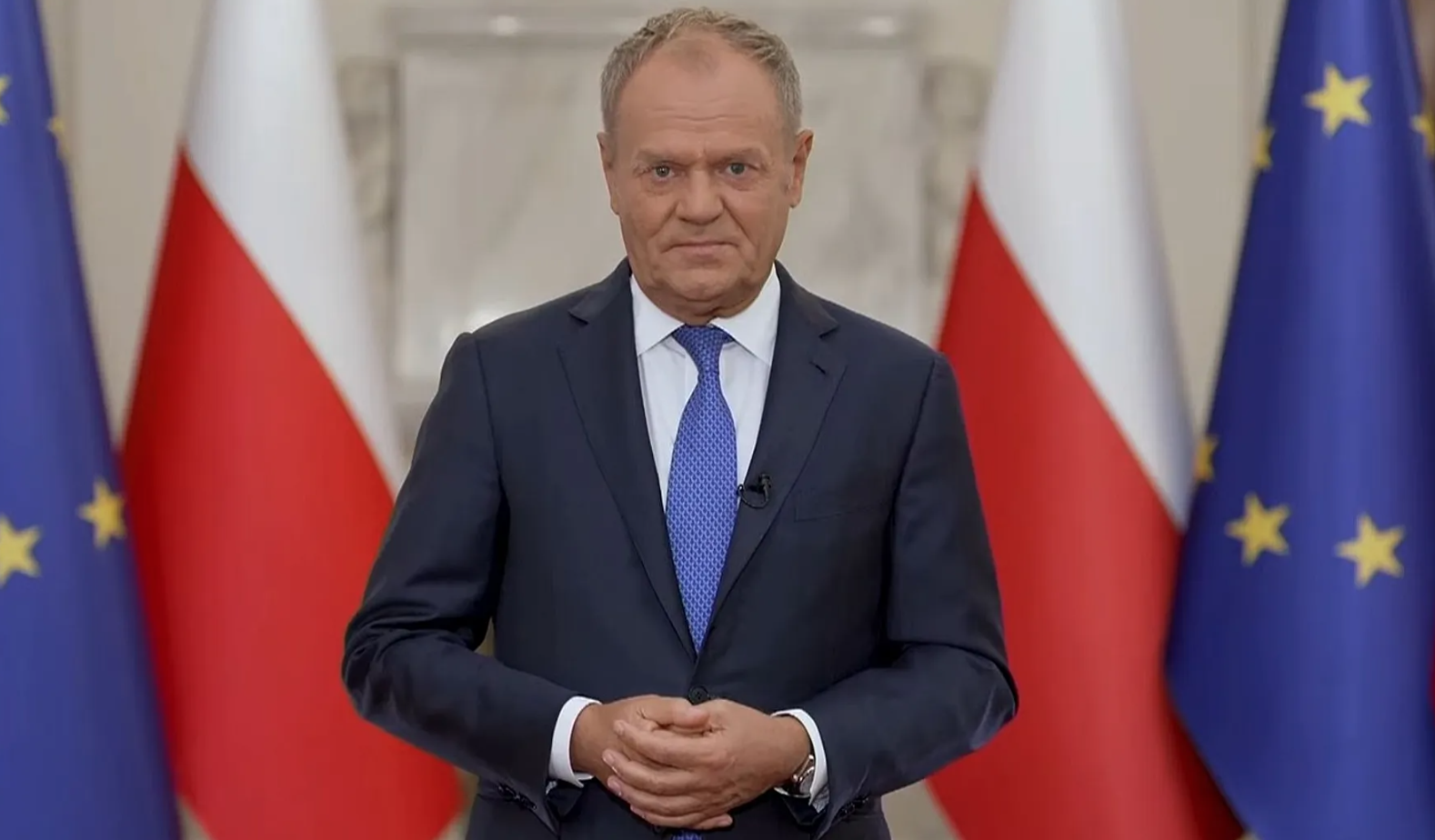
Europe · Rule of Law 31 October 2026 Poland’s Court War Reaches the Tribunal Door A suspended chief justice, riot police at the gates and a president who turned his plane around mid-flight. Donald Tusk says there is no compromise to be had. His opponents call it a coup. Photo: televised address, 31 Oct 2026 Smart Times · Europe Desk Warsaw 8 min read On Saturday evening, Prime Minister Donald Tusk addressed the nation on television and promised that the rule of law would prevail over violence, as the fight over Poland’s Constitutional Tribunal reached a breaking point. He offered no deal with President Karol Nawrocki and no detailed plan to end the standoff. The speech capped roughly 24 hours in which a decade-old legal dispute became a physical one. On Friday, 30 October, judge Anna Korwin-Piotrowska, one of the judges elected by the current parliament, ordered a one-month suspension of Tribunal president Bogdan Święczkowski and vice-president Bartłomiej Sochański, and took over management of the court. She said the step was needed to restore the court’s functioning and let every Sejm-elected judge take up their duties. The existing leadership rejected the order as having no legal basis, and argued that judges sworn in outside the presidential procedure are not full members of the Tribunal. Seven judges then entered the headquarters with State Protection Service officers, and scuffles broke out inside. The night at the gates Riot police, a mid-air U-turn, and a crowd that did not go home As word of the suspension spread, hundreds of supporters of the opposition Law and Justice party (PiS) gathered outside the court in Warsaw. Party leader Jarosław Kaczyński, former Prime Minister Mateusz Morawiecki and former Tribunal president Julia Przyłębska were among them. Police said their deployment followed information from Korwin-Piotrowska about possible threats to judges and staff. Three people were detained after objects were thrown at officers and some tried to break through the security fence. Nawrocki, a PiS ally who was flying to Senegal, ordered his plane back to Warsaw. He announced on X that at a moment like this, the President must be in Poland , went to the Tribunal during the night, and said he helped the suspended court president get into the building. By Saturday morning he was calling the events a breach of Poland’s constitutional order and summoned parliamentary group leaders for urgent talks on stabilising the situation. Protesters returned for a second night. In certain matters there can be no compromise. Donald Tusk · televised address, 31 Oct In his address, Tusk called Friday’s events scandalous and said calm could not be bought by accepting lawlessness. He likened PiS to a thief who snatches an elderly woman’s handbag and then complains of violence when someone takes it back. He insisted that no politician, the president included, has the right to enter a court, instruct judges or intimidate them, a clear reference to Nawrocki’s overnight visit. He also warned that pro-Russian networks and online bots were amplifying the conflict, and pledged that the government would guarantee the Tribunal the security it needs to work. The government’s case Restoring a captured court Tusk’s coalition says the Tribunal was politicised under PiS and that its current president repeatedly broke the law and jeopardised the court’s work. Foreign Minister Radosław Sikorski argued the standoff is about returning the rule of law to an institution that, in his account, had cases steered to hand-picked judges. It points to a Strasbourg interim order against obstructing the new judges, and to the Venice Commission’s view that the president’s role in the oath is ceremonial. Tusk · Sikorski · Civic Coalition The opposition’s case A judge who was never sworn in PiS and the presidential palace say the takeover was led by a judge whose oath the president never accepted, enforced by police inside a constitutional body. Morawiecki wrote that this is not how the rule of law is restored, warning that each new government will simply rewrite the rules again, and called for a lasting cross-party law on the Tribunal. Former Justice Minister Zbigniew Ziobro called the suspension a criminal attack on the constitutional order and urged resistance. Nawrocki · Kaczyński · Morawiecki · PiS 11 years since the first fight over Tribunal appointments, in 2015 4 Sejm-elected judges whose oaths Nawrocki refused in 2026 1 month: length of the suspension ordered for the court’s leadership 3 protesters detained by police outside the Tribunal on Friday night Background How a dispute over five seats became a constitutional crisis Each change of power since 2015 has brought new legal interpretations and new disputes over who gets to decide. Neither camp arrives with clean hands. 2015 The outgoing PO-PSL parliament elects five judges before the election, two of them prematurely. After PiS wins, the new Sejm annuls all five picks and installs its own; the Tribunal later rules three of the original appointments were valid. 2016 – 2021 PiS rewrites the Tribunal’s rules; the government refuses to publish a ruling striking them down. Julia Przyłębska becomes president. In 2021 the European Court of Human Rights finds the court’s composition fails the “established by law” test. 2023 – 2024 Tusk’s coalition wins power on a rule-of-law platform. President Andrzej Duda sends its reform bills to the Tribunal, freezing them, and in December 2024 appoints Bogdan Święczkowski , a former national prosecutor, as its head. The government stops publishing Tribunal rulings. March – May 2026 The Sejm elects six judges. Nawrocki accepts two oaths and refuses four. The four swear in before a notary; the Tribunal rules the president must be present. Strasbourg issues an interim measure telling Poland not to obstruct them. 30 – 31 October 2026 Korwin-Piotrowska suspends the court’s leadership and takes charge. Riot police surround the building , Nawrocki flies home, and Tusk addresses the nation vowing no compromise. Why it matters beyond Warsaw When a constitution has two referees For Smart Times readers, the crisis is not only a story about politics. Poland is one of the EU’s largest economies and a magnet for tech, fintech and manufacturing investment. When its highest constitutional court is split into rival camps, the uncertainty does not stay inside the building. What is at stake Legal certainty. Rulings that go unpublished, and state bodies that disagree about their force, leave open questions over laws touching businesses, taxation and public services. Information warfare. Tusk explicitly flagged Russian bot networks amplifying the conflict, turning a judicial fight into a platform-moderation and disinformation story. The 2027 ballot. At least one expert says the standoff could help or backfire on both Tusk and Nawrocki ahead of next year’s parliamentary elections. Brussels’ consistency. PiS is pressing EU institutions to apply the same rule-of-law scrutiny to today’s government that they applied to its predecessor. What to watch Korwin-Piotrowska has called a General Assembly of the Tribunal’s judges for 3 November , while Święczkowski says he and the remaining judges will try to regain control. Both sides now claim to be the court. Whichever assembly Poland’s institutions recognise next week may decide whether this ends in a negotiated law, or in two Tribunals.