UKRAINE'S OTHER WAR: ECONOMIC CORRUPTION
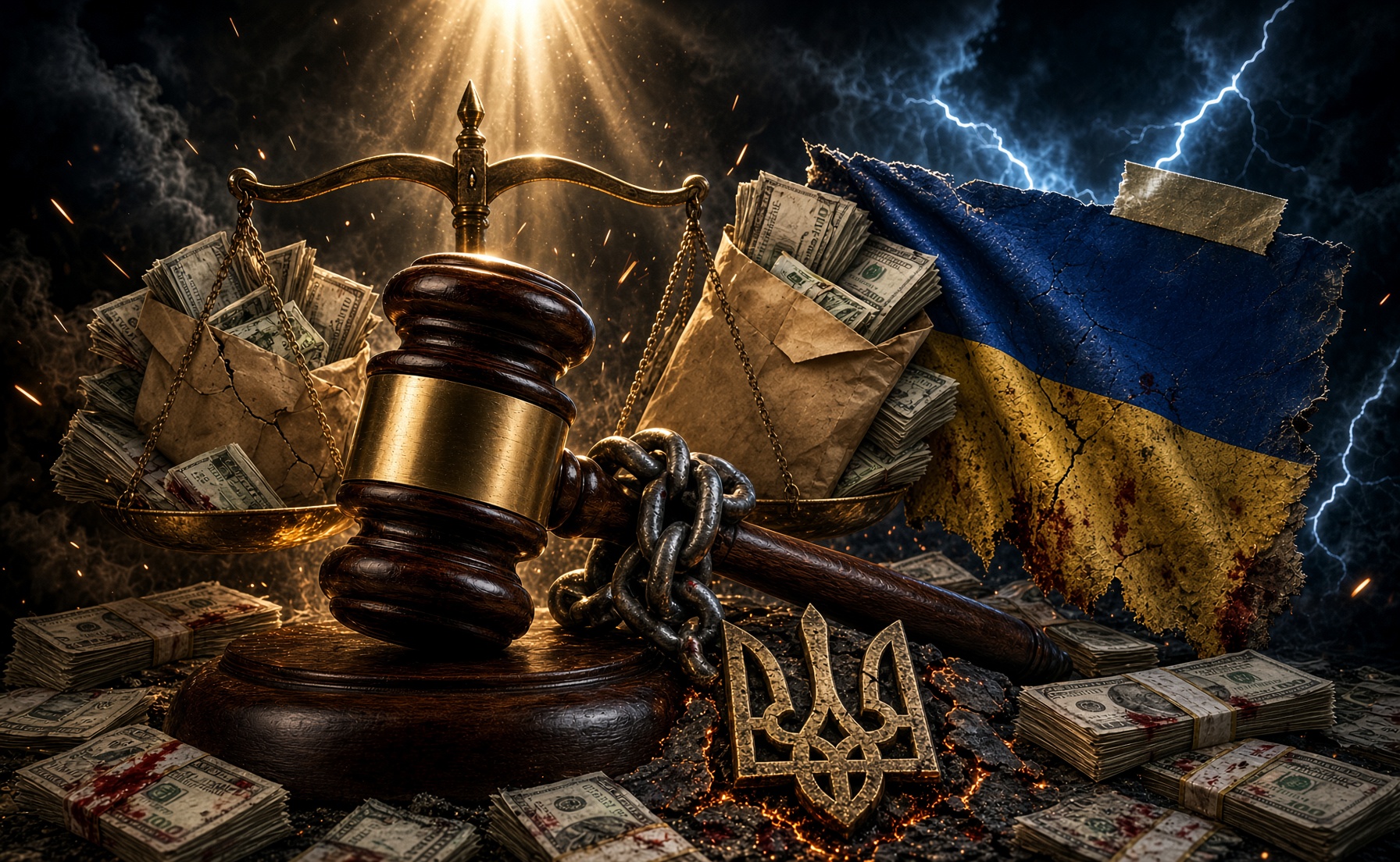
SMART TIMES Broadcast Network That Rewards Knowledge Smart Times · Anti-Corruption · Special Report Ukraine’s Other War: Economic Corruption, the Headless ARMA, and the Water Empire of a Russian Oligarch The prosecutor’s office is under investigation, the energy sector is in court, the SBU is in the dock — but the most dangerous corruption is the quiet kind: the kind that manages billions in seized assets and answers to no one. By Smart Times Anti-Corruption Desk · Kyiv · November 7, 2026 Royal Romance, the yacht linked to Viktor Medvedchuk, remains unsold years after its arrest — a symbol of Ukraine’s paralyzed asset-management system. Illustration: Smart Times Ukraine is fighting two wars at once. The first is visible: trenches, missiles, blackouts. The second has no front line. It is fought in the registries of the Ministry of Justice, in the server rooms of the state asset agency, in the quiet rooms where the fate of billions of hryvnias in arrested property is decided. And it is in this second war that Ukraine is losing ground. I. The loud corruption: prosecutors, energy, the SBU The autumn of 2026 has read like a crime novel written by the National Anti-Corruption Bureau itself. On November 4, NABU and the Specialized Anti-Corruption Prosecutor’s Office announced a new phase of Operation Carthage : a criminal organization in which serving officials of the Security Service of Ukraine, the Prosecutor General’s Office and the National Police — acting together with figures from the criminal underworld — allegedly provided protection for fraudulent call centers scamming Ukrainians and foreigners, for drug sales, and for the illegal production of counterfeit cigarettes and foreign currency. At least twelve people were involved; five suspicion notices followed within twenty-four hours. Carthage is not an isolated case; it is a pattern. The Midas investigation into the corruption empire built around Energoatom — the scandal that broke a year ago and reached into the president’s inner circle — has now been completed by NABU, with new money-laundering suspicions served as recently as July 10 against operative Dmytro Basov. Former energy and justice minister Herman Halushchenko walked out of custody on bail on June 29. That bail money, investigators say, had its own story. On August 19, NABU unveiled Operation Forest Gump : a group that allegedly laundered UAH 150 million in cash through front companies, having gained de facto control of Sens Bank — money intended, among other things, to post bail for a figure in the energy corruption case. A day later came Operation Femida : a raiding organization allegedly led by sitting and former MPs, staffed with officials of the Office of the President and the Ministry of Justice, judges and hackers, seizing Kyiv real estate and enterprises worth more than UAH 955 million by interfering in state registries and forging court rulings. Add to this the picture Smart Times documented in the October Corruption Risk Index: the October 21 search of National Bank Governor Andriy Pyshnyi’s premises, the October 30 suspicion served on Ukroboronprom deputy director Taras Shiyko over UAH 1.1 billion in phantom brokerage, the fabricated forensics in the unexplained-wealth probe of former SBU cyber chief Illia Vitiuk. Prosecutors, bankers, spies, generals — the whole vertical of the state, touched by suspicion. II. Why the quiet corruption is worse than the war All of this is shocking. And yet none of it is the most dangerous corruption in Ukraine today. Russian aggression destroys Ukraine from the outside — and is met with resistance, mobilization, and solidarity. Economic corruption destroys it from the inside, and is met with shrugs. A missile can level a power station; a corrupt manager can ensure the station is never worth rebuilding. A rocket costs Russia money; a siphoned asset pays the enemy’s admirers here at home. The Kremlin spends billions to convince the West that Ukraine is a black hole for aid. Ukraine’s own economic corruption makes that argument for free, in every audit report, in every congressional hearing, in every postponed tranche. Worst of all, this corruption operates in plain sight and under full legal cover — through the very institution created to turn the property of traitors and oligarchs into money for the army: the Asset Recovery and Management Agency, ARMA. “The bill includes the long-awaited independent audit of ARMA, a transparent procedure for selecting its head with the participation of international partners.” — Anastasia Radina, head of the Verkhovna Rada Anti-Corruption Committee, on the ARMA reform law III. ARMA: an agency without a head ARMA has not had a permanent head since July 30, 2025, when the government dismissed Olena Duma on the very day the reform law — authored by Radina — entered into force. The competition that followed became a parable of how not to select anyone. Applications opened on December 19, 2025, and were extended to February 9, 2026. Twenty candidates applied. When the competition commission approved the results of the cognitive-skills test on March 25, 2026, exactly one of the thirteen tested candidates had cleared the bar of 107 points: Viktor Dubovyk — director general of the Legal Policy Directorate of the Office of the President . Twelve rivals failed the same test. Commission member Rita Simosh raised concerns about the strikingly low competition and proposed reviewing the testing parameters; the majority refused to change the rules mid-race. The candidate the presidential office had effectively been left alone with then failed the interview on April 16 — voted down by, among others, Transparency International Ukraine’s Kateryna Ryzhenko. And in August, Viktor Dubovyk was arrested in the Femida case. On August 21 the High Anti-Corruption Court sent him to pre-trial detention for sixty days with bail set at UAH 7 million; on September 1 the HACC Appeals Chamber left the measure unchanged. The man the system had all but appointed to manage Ukraine’s seized billions is now in a detention center, accused of helping a criminal organization seize other people’s property through forged court decisions. The agency has since been run by an acting head, Yaroslava Maksymenko. And on October 26, Prime Minister Serhiy Koretsky — in office only since July 16 — stood before the public to announce a new “open and transparent” competition for the head of ARMA. Koretsky is in an unenviable position: he inherited a discredited contest, a decapitated agency and a budget that sees almost nothing from the billions under arrest. Restarting the competition under fire means owning the failure; not restarting it means owning the paralysis. IV. A yacht that cannot be sold, crypto that cannot be counted The flagship case of ARMA’s paralysis is the 92-meter yacht Royal Romance , linked to Viktor Medvedchuk — the first asset of its kind in the agency’s history. The Cabinet approved its sale back in February 2024; the Dutch auction house Troostwijk won the mandate; in July 2024 a Croatian court lifted the arrest. Since then: silence and litigation. In April 2026 ARMA announced the case had entered “the final stage of preparation for sale,” complaining of legal resistance from Medvedchuk’s side. Two and a half years after the sale was approved, the yacht has brought the budget exactly nothing. Its sister case, the yacht Amore Mio, has been reduced to an Interpol notice in the Stolen Vessels database. Or take cryptocurrency. On August 14, 2026, Kyiv’s Pechersk district court allowed ARMA to sell more than 8.3 million USDT seized from a transnational hacker group and held on the WhiteBIT exchange. The decision exposed a regulatory vacuum: there is no law governing what the state may do with seized virtual assets at all. “If ARMA procedurally cannot realize the crypto assets for lack of legal regulation, it would have been simpler to leave them seized with the pre-trial investigation body than to simply transfer them from wallet to wallet ‘for show’. Who has access to this wallet, and under what act such access and responsibility are regulated, is unknown.” — Pavlo Velykorechanin, former deputy head of ARMA, expert of the Rada Anti-Corruption Committee A yacht unsold. Crypto shuttled between wallets with no lawful owner of the keys. Revenues to the state budget: close to zero. This is the machine that was supposed to make aggression unprofitable — and cannot even make punishment profitable. V. The crown jewel: IDS Ukraine goes to a law bureau Against this backdrop, ARMA this autumn ran its most valuable management competition ever: the seized corporate rights of IDS Ukraine , the country’s largest bottled-water producer, linked to sanctioned Russian oligarch Mikhail Fridman. The portfolio — Morshynska, Myrhorodska, Alaska, Aqua Life — controls over 40% of Ukraine’s bottled-water market, employs roughly 3,000 people, carries UAH 4 billion in net assets and generated UAH 7.4 billion in 2025 revenue. The process had an ominous overture: on August 18, ARMA reported a hacker attack on its servers on the eve of the competition. On September 4, the selection commission — chaired by business ombudsman Anka Feldhuzen — admitted five contenders to the electronic auction, assuring the public that legality and transparency would be guaranteed “at every stage.” The auction on September 7 produced a winner that raises more questions than it answers. The lowest bid — 0.01% of net profit, from asset manager Ukrkapital — was rejected as abnormally low and insufficiently justified. The mandate went instead to the second-lowest offer: 0.9% of net profit from the Legal Bureau “Prioritas” — a company registered in 2013, founded, owned and directed by a single lawyer, Zhanna Yefremova, whose 2025 revenue was UAH 812,000 and whose net profit was UAH 8,400. The protocol was signed on September 21 and approved on September 23; as of this writing, the management contract for a UAH 4-billion business has still not been concluded. On October 7, Anastasia Radina publicly stated that the anti-corruption committee has questions about possible violations in the selection that made Prioritas the winner of the IDS Ukraine corporate rights. She is fighting — visibly, almost single-handedly — to keep the reform she authored from becoming its own parody. VI. Washington is watching The signal has crossed the ocean. In Washington, where billions in U.S. assistance to Ukraine are already overseen by more than twenty federal agencies, the corruption wave reaching into the president’s inner circle has moved from the op-ed pages to the oversight agenda of Congress. The GAO has flagged fraud-risk gaps in assistance programs; lawmakers who once asked “how much does Ukraine need?” now ask “who manages what we have already seized?” A water empire of a sanctioned Russian oligarch handed to a two-person law bureau, a headless asset agency whose anointed chief sits in jail — these are not Kyiv talking points. They are the talking points of those in Congress who want the aid stopped. VII. Timeline: how the ARMA contest collapsed Jul 30, 2025 ARMA head Olena Duma dismissed; Radina’s reform law takes effect the same day. The agency begins fifteen months without a permanent chief. Dec 19, 2025 Competition for a new ARMA head opens; applications later extended to February 9, 2026. Twenty candidates apply. Mar 25, 2026 Only one candidate passes the cognitive test: Viktor Dubovyk of the President’s Office. Concerns about the contest’s credibility are raised inside the commission. Apr 16, 2026 Dubovyk fails the commission interview; international and civil-society members vote against. The competition collapses with no winner. Aug 21, 2026 Dubovyk is jailed in the Femida raiding case; bail set at UAH 7 million. Appeals court upholds detention on September 1. Sep 23, 2026 ARMA commission approves Prioritas — a micro law bureau — as manager of Fridman-linked IDS Ukraine at 0.9% of net profit. Contract unsigned. Oct 26, 2026 PM Serhiy Koretsky announces a new “open and transparent” competition for ARMA head — starting over from zero. By the numbers 15+ months ARMA has been without a permanent head UAH 7.4bn 2025 revenue of IDS Ukraine, handed to a bureau with UAH 812k turnover 8.3m USDT seized hacker crypto the state was only allowed to sell in August 2026 €0 budget proceeds from the Royal Romance yacht, 2.5 years after sale approval None of this requires Russian missiles. It requires only indifference — and the quiet hope, in certain offices, that no one is counting. Someone is counting. Next week · Exclusive Smart Times publishes an insider account of how the IDS Ukraine competition was really run — who called whom, who set the terms, and who was meant to win. Stay tuned.