LVMH reported full-year 2025 revenue of €80.8 billion on January 27, 2026, down 5% reported and 1% organically from €84.7 billion in 2024. This marks the first annual revenue decline since the pandemic period and reflects post-COVID normalization, currency headwinds, and softer demand in key categories.
Profit from recurring operations fell 9% to €17.8 billion, with operating margin contracting to 22.0% from 23.1%. Group share of net profit dropped to €10.9 billion. Operating free cash flow increased 8% to €11.3 billion, and net debt declined 26% to €6.9 billion.
Fourth-quarter organic revenue growth of +1% exceeded consensus expectations for a slight decline, driven by improving trends in Asia (ex-Japan) and resilience in selective retailing.
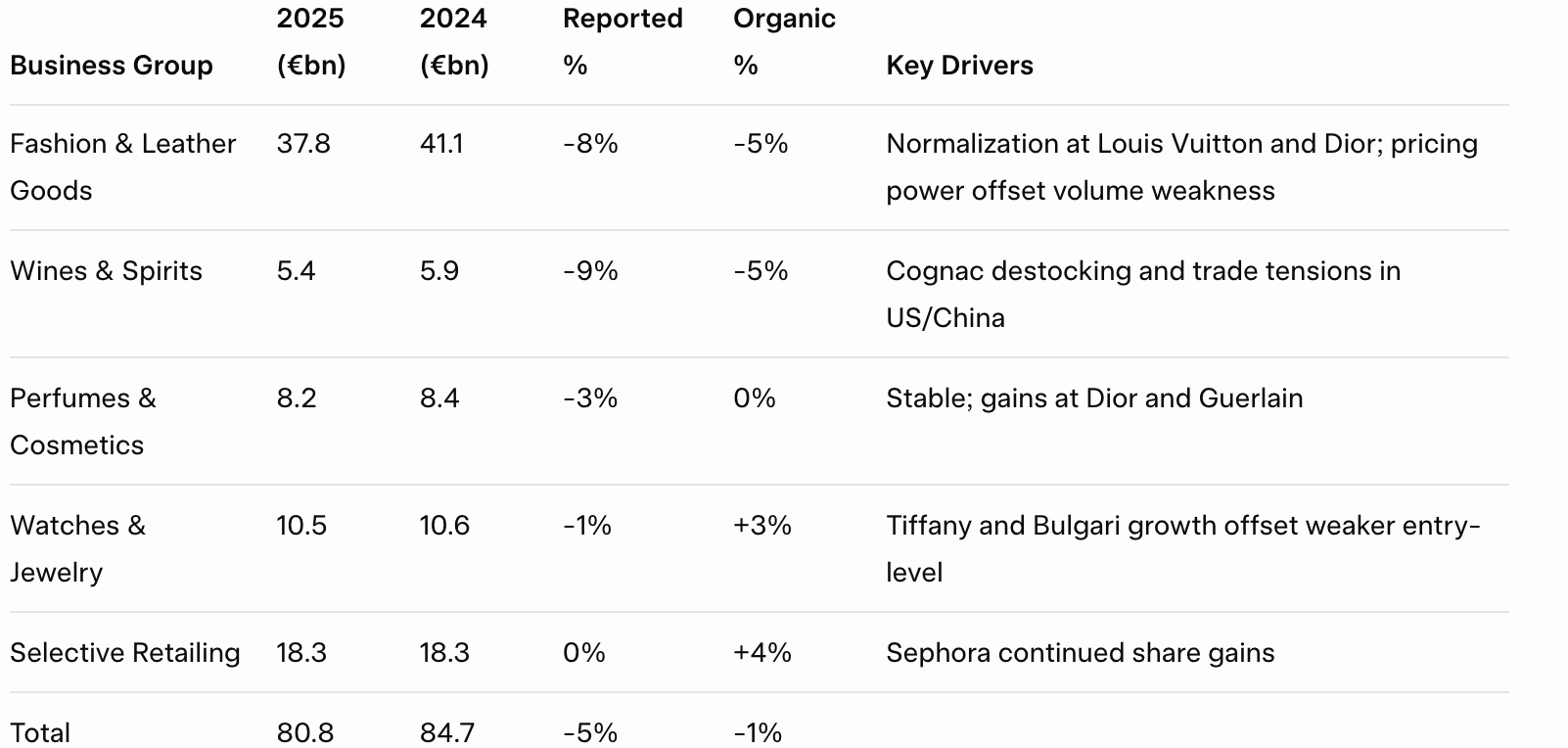
Revenue by Business Group (2025 vs. 2024)
Profit from recurring operations fell 9% to €17.8 billion, with operating margin contracting to 22.0% from 23.1%. Group share of net profit dropped to €10.9 billion. Operating free cash flow increased 8% to €11.3 billion, and net debt declined 26% to €6.9 billion.
Fourth-quarter organic revenue growth of +1% exceeded consensus expectations for a slight decline, driven by improving trends in Asia (ex-Japan) and resilience in selective retailing.
Revenue by Business Group (2025 vs. 2024)
Segment Analysis
Fashion & Leather Goods (47% of revenue, ~70% of recurring profit) absorbed the bulk of the decline. Organic drop of 5% reflects reduced aspirational spending and inventory caution among retailers. Core brands Louis Vuitton and Dior maintained pricing discipline but saw lower footfall from Chinese tourists and softer US demand.
Wines & Spirits faced ongoing pressure from high inventories in US distribution channels and reduced Chinese demand amid economic caution. Hennessy cognac volumes remained weak.
Watches & Jewelry showed relative resilience with 3% organic growth, led by high-jewelry lines at Tiffany and Bulgari. Entry-price watches lagged.
Selective Retailing delivered consistent mid-single-digit growth, almost entirely from Sephora’s store expansion and market-share gains in beauty.
Regional Trends
Asia (ex-Japan) returned to growth in H2 after earlier declines, signaling sequential improvement among mainland Chinese consumers. Japan softened versus 2024’s tourism peak. Europe saw H2 declines due to reduced tourist spending and weaker euro. US maintained stable local demand but lower inbound tourism impact.
Profitability and Cash Flow
Operating margin compression of 110 basis points came primarily from Fashion & Leather Goods (estimated ~35% margin vs. prior high-30s) and currency effects. Cost control limited the damage; marketing spend remained elevated to support brand desirability.
Free cash flow strength enabled continued deleveraging and a proposed €13 dividend per share (€5.50 interim paid; €7.50 balance in April 2026).
Historical Context
Revenue of €80.8 billion places 2025 roughly in line with 2022 levels (€79.2 billion), erasing two years of post-pandemic gains. Compound annual growth from 2019 (€53.7 billion) to 2025 stands at ~7%, still robust over the cycle.
Comparison to Peers and Expectations
Q4 organic growth of +1% beat consensus estimates of flat-to-negative, driving positive initial share reaction and broader luxury sector relief. Hermes continued to outperform with sustained double-digit growth. Richemont reported resilient jewelry demand. Kering remained weaker due to Gucci turnaround challenges.
2026 Outlook
Management highlighted ongoing geopolitical and currency uncertainty but noted improving Asian trends and cost discipline. Sector forecasts point to low- to mid-single-digit global luxury growth in 2026, led by gradual Chinese recovery and stable US/Europe local demand. Risks include prolonged trade tensions, yen/euro volatility, and potential recessionary pressure on aspirational consumers.
Investment Considerations
Balance sheet remains strong with low net debt and high cash generation. Dividend yield attractive at current levels. Valuation reflects cycle normalization but retains premium to broader market on brand durability and cash return potential. Near-term catalysts center on sustained Asia momentum and margin defense.