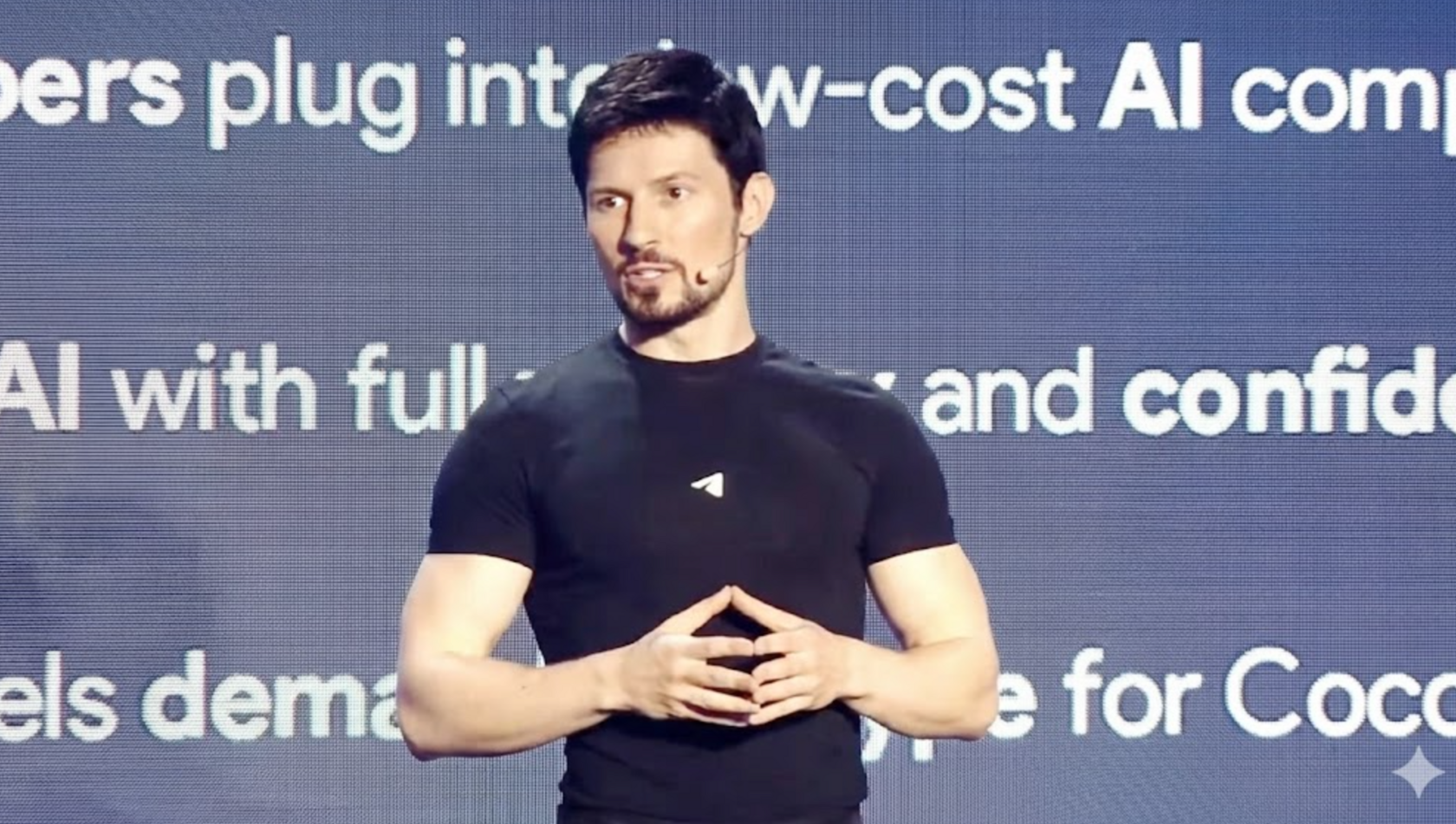
Telegram founder Pavel Durov announced on November 30, 2025, that Cocoon, the Confidential Compute Open Network built on the TON blockchain, has launched. The platform is now processing initial AI inference requests with full data encryption, ensuring no visibility into user queries or outputs for network participants. GPU providers connected to the network have begun earning Toncoin (TON) rewards for supplying compute resources.
Cocoon operates as a decentralized marketplace for AI workloads. Developers submit requests specifying model architecture—such as DeepSeek or Qwen—along with expected daily volume and average token size. These requests are routed to available GPUs, with payments made in TON. All data remains encrypted end-to-end, enabling private AI processing without intermediaries accessing content. The network's source code and documentation are available at https://cocoon.org, supporting open participation.
This model addresses limitations in centralized AI compute services from providers like Amazon Web Services and Microsoft Azure. Those platforms charge premium rates—often $2–$5 per hour for high-end GPUs—while retaining access to user data for training and analytics. Cocoon eliminates these markups by directly matching supply and demand on-chain, potentially reducing costs by 50–70% based on initial benchmarks from similar decentralized networks. Privacy is enforced through confidential computing protocols, aligning with growing regulatory demands under frameworks like the EU AI Act.
TON benefits directly as the native token for transactions and rewards. GPU owners stake hardware to mine TON, with earnings tied to request volume and compute efficiency. Early adopters report yields equivalent to 10–15% annualized returns on mid-range GPUs, assuming consistent demand. Developers pay in TON, creating buy pressure, while Telegram—positioned as Cocoon's inaugural client—will integrate the network for user-facing AI tools, such as chat enhancements and content generation.
Cocoon operates as a decentralized marketplace for AI workloads. Developers submit requests specifying model architecture—such as DeepSeek or Qwen—along with expected daily volume and average token size. These requests are routed to available GPUs, with payments made in TON. All data remains encrypted end-to-end, enabling private AI processing without intermediaries accessing content. The network's source code and documentation are available at https://cocoon.org, supporting open participation.
This model addresses limitations in centralized AI compute services from providers like Amazon Web Services and Microsoft Azure. Those platforms charge premium rates—often $2–$5 per hour for high-end GPUs—while retaining access to user data for training and analytics. Cocoon eliminates these markups by directly matching supply and demand on-chain, potentially reducing costs by 50–70% based on initial benchmarks from similar decentralized networks. Privacy is enforced through confidential computing protocols, aligning with growing regulatory demands under frameworks like the EU AI Act.
TON benefits directly as the native token for transactions and rewards. GPU owners stake hardware to mine TON, with earnings tied to request volume and compute efficiency. Early adopters report yields equivalent to 10–15% annualized returns on mid-range GPUs, assuming consistent demand. Developers pay in TON, creating buy pressure, while Telegram—positioned as Cocoon's inaugural client—will integrate the network for user-facing AI tools, such as chat enhancements and content generation.
Scaling efforts are underway. Over the coming weeks, the team plans to onboard additional GPU capacity and developer integrations. This follows Durov's unveiling at Blockchain Life 2025 in Dubai, where he highlighted Telegram's 1 billion monthly active users as a demand driver at the intersection of blockchain, AI, and social platforms. No specific timelines for full Telegram rollout were disclosed, but the focus remains on expanding confidential features to end-users.
For investors, Cocoon represents a concrete expansion of TON's utility beyond payments and DeFi. With AI compute projected to reach $500 billion in market value by 2030, decentralized alternatives could capture 5–10% share if adoption mirrors trends in DePIN projects. Track progress via official channels and monitor TON price action around GPU onboarding milestones.
For investors, Cocoon represents a concrete expansion of TON's utility beyond payments and DeFi. With AI compute projected to reach $500 billion in market value by 2030, decentralized alternatives could capture 5–10% share if adoption mirrors trends in DePIN projects. Track progress via official channels and monitor TON price action around GPU onboarding milestones.