Generation Transparency: Why Ukraine's Young People Are the Last Line Against Corruption
They fought on the front lines and in the streets. Now the generation that grew up under occupation and war is demanding something harder to win — a state that cannot be stolen.
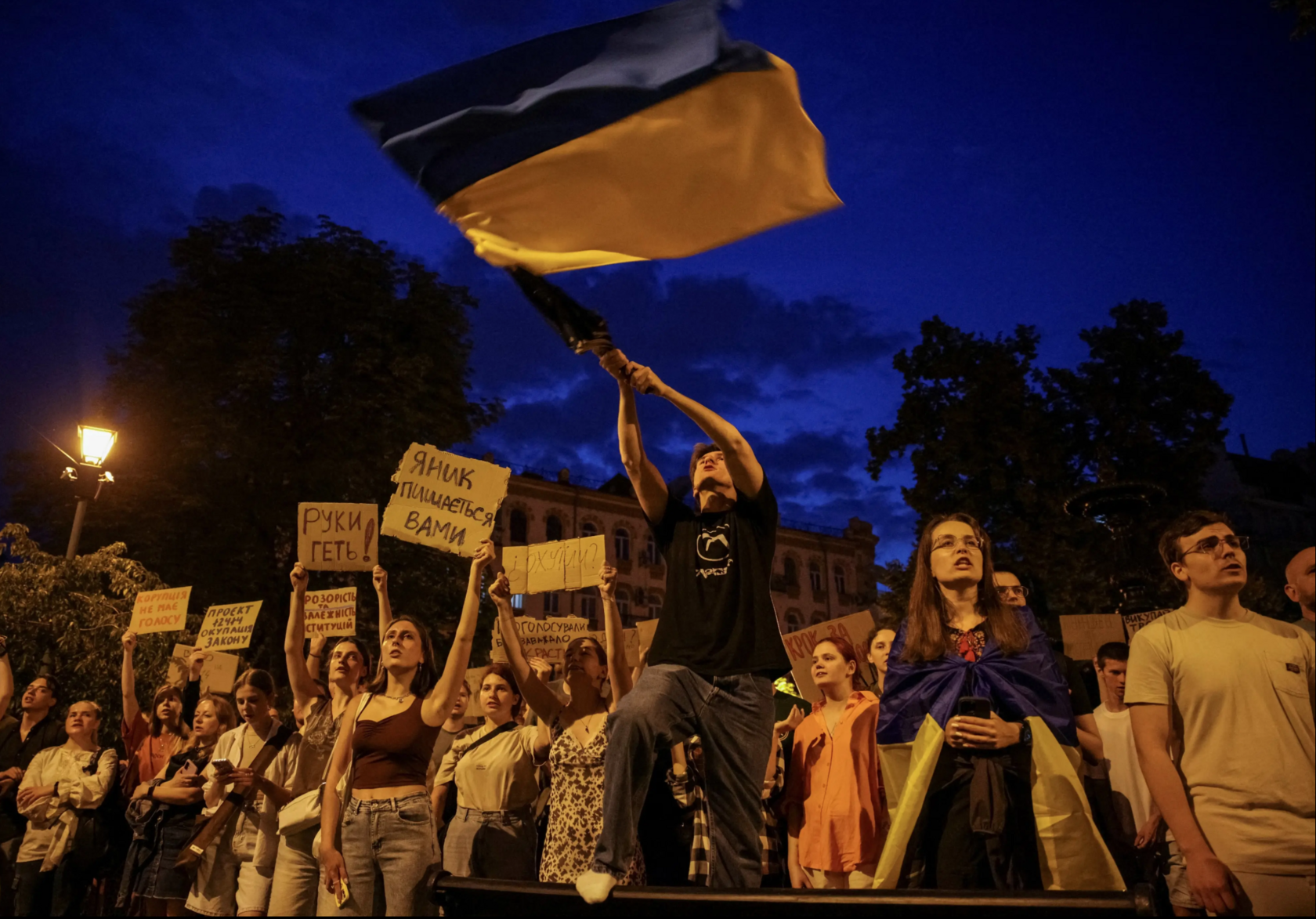
In the summer of 2025, a 25-year-old soldier on leave stood outside the Verkhovna Rada holding a piece of cardboard on which he had written, in marker, "We are not fighting for this." He was one of thousands who poured into the streets of 17 Ukrainian cities in nine days, forcing the reversal of a law that would have handed a presidential appointee control over Ukraine's two flagship anti-corruption agencies. The law was gone within a week. The soldier went back to the front.
That moment — quiet, determined, written in black marker on salvaged cardboard — may come to define what Ukrainian civic life looks like in the post-war era. Not grand gestures. Not party slogans. The specific, informed demand that a specific institution be protected from a specific political maneuver. That is what a generation raised on transparency, open data, and institutional distrust sounds like when it speaks.
The information that changes everything
Ukraine's younger citizens came of age inside a set of tools their parents never had. Prozorro — the open procurement platform — went live in 2016. The asset declaration register, forced on politicians by reform pressure, created a searchable archive of official wealth. NABU, founded the same year, gave investigators institutional independence for the first time. And a generation of journalists — at Kyiv Independent, Ukrainska Pravda, Skhemy — built careers turning that data into readable, shareable accountability stories.
The result is a generation that does not merely know corruption is a problem in the abstract. They know the name of the official, the number of the case, the amount of the alleged kickback, and the institution that is supposed to be prosecuting it. When Bill 12414 passed and that institution was suddenly under threat, they knew exactly what had been lost — and exactly what needed to be restored.
"The front is holding — the rear is falling apart."
That specificity of knowledge is itself a form of power. The Ukraine Corruption Risk Index — a living analytical instrument tracking 100-plus Ukrainian public figures by their documented exposure to corruption investigations, sanctions, and press findings — exists to make that kind of knowledge portable. It is built for American journalists, officials, and investors who need to understand the Ukrainian institutional landscape quickly. But its logic is the same logic that drives every open-data reform in Ukraine: sunlight, structured and searchable, changes what is possible.
The numbers young Ukrainians need to know
The CRI's April 2026 edition reflects the landscape those young activists were defending. The figures below are not abstractions. They are the people whose decisions shape whether reconstruction money flows where it should, whether a soldier's family gets the support they were promised, whether the country that emerges from this war is one worth fighting for.
The gap between those scores is the gap the younger generation is trying to close: between the institutions that investigate corruption (low scores, high public trust) and the political actors who have the most to fear from those investigations (high scores, high risk). The CRI's methodology is explicit: a low score does not mean a figure is unimportant. It means the evidence of documented risk is low. Kryvonos and Klymenko score low precisely because they are doing their jobs.
Sharing the score: why distribution is everything
Anti-corruption work fails when it stays in specialist circles. The investigation published, the score assigned, the sanction issued — these matter only if they reach the people who can act on them. In Ukraine's case, that means young voters who will choose governments, young soldiers who will decide what kind of state is worth defending, young professionals in the diaspora who will decide whether to return and build.
The research is consistent on this: corruption thrives on information asymmetry. When the public cannot easily learn which official is under investigation, which procurement contract was inflated by 30%, or which oligarch's associate sits on the energy ministry board, the system relies on that ignorance to perpetuate itself. Open data tools — Prozorro, asset declarations, the CRI itself — are designed specifically to destroy that asymmetry. But tools only work if they are used.
- Search officials by name before deciding whether to trust their public statements
- Check the category and risk band of any figure who appears in reconstruction news
- Share individual scores when reporting on or discussing official appointments
- Use score movement over time to track whether anti-corruption pressure is working
- Cite the index in citizen journalism, academic work, and policy submissions
The July 2025 protests were, among other things, a demonstration of what happens when a generation has internalized this logic. Protesters did not arrive with vague grievances. They arrived knowing that NABU had 15 of its detectives raided the day before the vote on pretextual grounds. They knew which MP had cast which vote. They knew the name of the prosecutor general who stood to gain new powers. The cardboard signs were the end product of years of civic education delivered not by schools, but by open registers, investigative newsrooms, and civil society organizations that treated transparency as a weapon.
Reconstruction money and the generation that will spend it
Ukraine's reconstruction costs are estimated in the hundreds of billions of dollars. That money — from the EU, from the US, from multilateral institutions — will flow through procurement systems, regional governments, and state enterprises. It will create opportunities for the kind of corruption that has historically followed post-war reconstruction elsewhere. The question of whether Ukraine will be different is, in very large part, a question about whether its younger generation has the tools and the will to watch where the money goes.
The OECD's warning in July 2025 was direct: undermining NABU and SAPO would compromise the credibility of partners "considering investing in Ukraine's defense sector and its long-term reconstruction." The connection between anti-corruption architecture and foreign capital is not rhetorical. It is the mechanism by which institutional quality gets priced into investment decisions, aid disbursements, and IMF program conditions. When young Ukrainians protect NABU, they are not being idealistic. They are protecting the conditions under which their country gets to rebuild.
"People are giving their lives for our future, and the authorities are destroying it."
The CRI as a living instrument for the next generation
The Ukraine Corruption Risk Index will publish Version 6 in May 2026. It will incorporate Yermak's resignation, the full aftermath of the Law 12414 reversal, new HACC proceedings from Operation Midas, and updated scores for every figure in the index. It is designed to be updated monthly, precisely because the landscape changes — officials fall, investigations close, new figures enter public life.
That living quality matters for younger audiences in particular. A static list of corrupt officials is an artifact. A dynamic, updatable index is a civic tool. It can tell you not just who scored high in 2024, but whether the trend is improving — whether prosecutions are advancing, whether the figures who orchestrated the July 2025 attack on NABU are facing consequences, whether the institutions that young Ukrainians went into the streets to defend are actually gaining strength or merely surviving.
The answer, as of April 2026, is cautiously the latter. The institutions survived. The scores of the people who attacked them have risen. The scores of the people who defended them remain low. The generation that wrote on cardboard in the summer of 2025 will decide, in the years that follow, whether that gap continues to widen or finally starts to close.