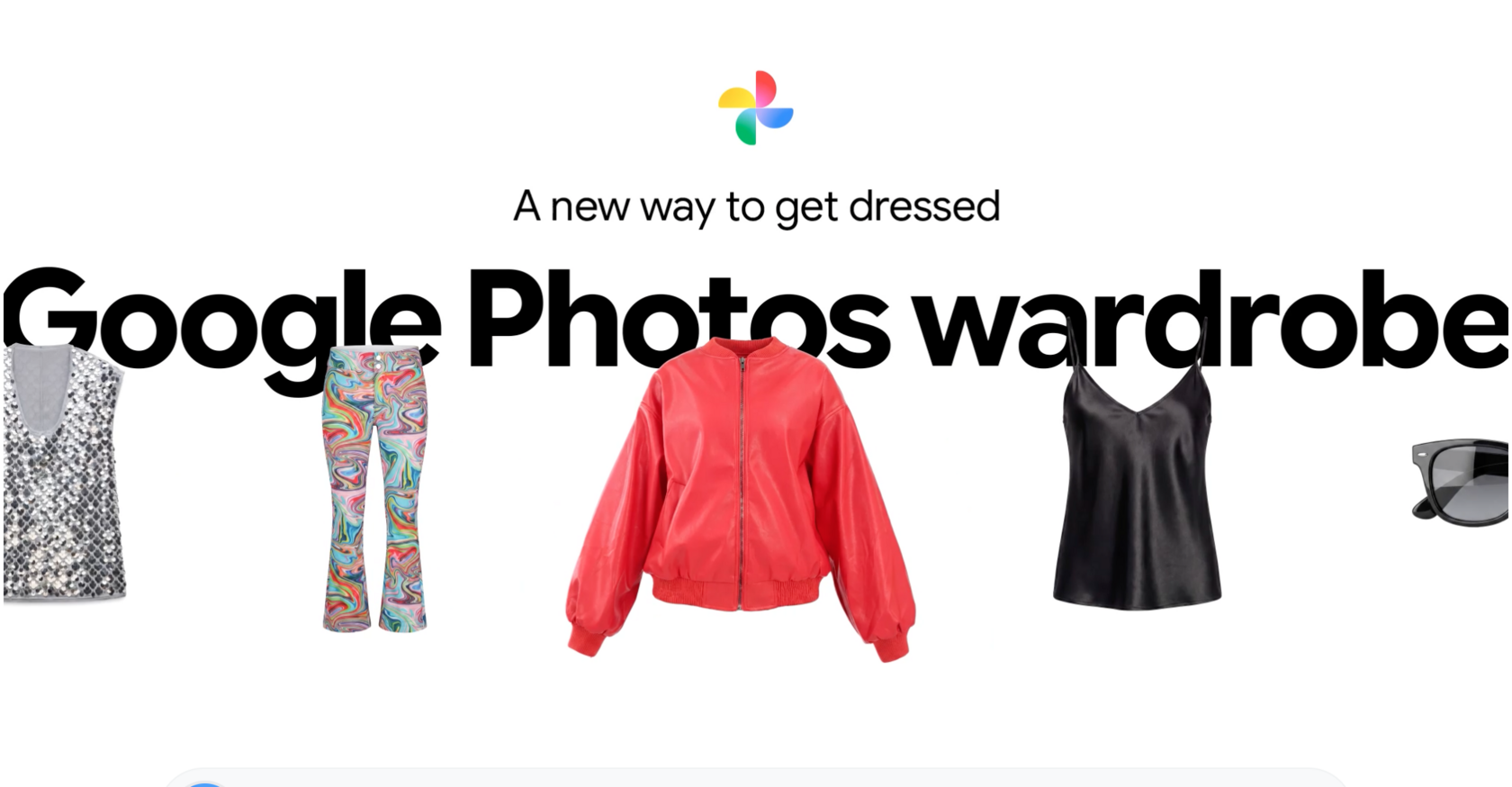
Google announced one of the most consequential consumer-facing fashion features in years: a new Google Photos wardrobe tool that uses AI to automatically catalog every piece of clothing in a user's photo library, then lets them mix, match, moodboard, and virtually try on outfits before they get dressed. Rolling out summer 2026 — Android first, then iOS.
The mechanics, per Google's announcement:
The wardrobe feature automatically builds a "wardrobe" collection from the clothing that appears in your existing photos library — no scanning, no manual upload, no separate app required. Users can filter by category (jewelry, tops, bottoms), mix and match items into outfits, save those outfits to moodboards for occasions ("summer weddings," "trip to Italy," "work outfits"), and use the virtual try-on tool to preview how a look will appear on them before getting dressed.
This sounds simple. It is, in fact, a structural shift.
Why this matters more than the headline suggests
For the entire history of fashion ecommerce, the digital wardrobe has been the missing primitive. Every styling app, every AI personal-shopper startup, every closet-organization tool of the last 15 years has tried to solve the same problem: how do you get a user to upload, tag, and maintain a digital twin of their physical wardrobe? The answer, repeatedly, has been: you don't. The friction is too high. People don't photograph their clothes one by one. They photograph their lives.
Google just removed that friction in a single product update. By passively extracting wardrobe data from billions of existing photos already sitting in Google Photos libraries, the world's largest photo platform has given itself the most comprehensive personal wardrobe dataset on earth — overnight.
For Smart Fashion, this is the consumer-facing entry point of the new stack we keep mapping:
AI does the categorization, the styling, and the try-on rendering. Personal data becomes a navigable, programmable asset. Agentic commerce is the obvious next step — recommend, source, complete the gap.
The implications across our Smart Fashion Council ranking
Google Photos turning every user library into a digital wardrobe is the closest thing fashion has had to a WhatsApp moment — a single, free, passively activated feature that suddenly makes a previously friction-heavy behaviour effortless for billions of people.
The wealth transfer from the old fashion system to the new just gained its consumer onboarding flow. The Smart Fashion stack — good money + RWA + AI — now has a default app experience millions will encounter without ever installing anything new.
Brands that adapt to this in the next 6-12 months will be the algorithmically-recommended, agent-purchased, on-chain-authenticated winners of the next decade. The rest will keep posting press releases about being repriced down in bits.
The mechanics, per Google's announcement:
The wardrobe feature automatically builds a "wardrobe" collection from the clothing that appears in your existing photos library — no scanning, no manual upload, no separate app required. Users can filter by category (jewelry, tops, bottoms), mix and match items into outfits, save those outfits to moodboards for occasions ("summer weddings," "trip to Italy," "work outfits"), and use the virtual try-on tool to preview how a look will appear on them before getting dressed.
This sounds simple. It is, in fact, a structural shift.
Why this matters more than the headline suggests
For the entire history of fashion ecommerce, the digital wardrobe has been the missing primitive. Every styling app, every AI personal-shopper startup, every closet-organization tool of the last 15 years has tried to solve the same problem: how do you get a user to upload, tag, and maintain a digital twin of their physical wardrobe? The answer, repeatedly, has been: you don't. The friction is too high. People don't photograph their clothes one by one. They photograph their lives.
Google just removed that friction in a single product update. By passively extracting wardrobe data from billions of existing photos already sitting in Google Photos libraries, the world's largest photo platform has given itself the most comprehensive personal wardrobe dataset on earth — overnight.
For Smart Fashion, this is the consumer-facing entry point of the new stack we keep mapping:
AI does the categorization, the styling, and the try-on rendering. Personal data becomes a navigable, programmable asset. Agentic commerce is the obvious next step — recommend, source, complete the gap.
The implications across our Smart Fashion Council ranking
Google Photos turning every user library into a digital wardrobe is the closest thing fashion has had to a WhatsApp moment — a single, free, passively activated feature that suddenly makes a previously friction-heavy behaviour effortless for billions of people.
The wealth transfer from the old fashion system to the new just gained its consumer onboarding flow. The Smart Fashion stack — good money + RWA + AI — now has a default app experience millions will encounter without ever installing anything new.
Brands that adapt to this in the next 6-12 months will be the algorithmically-recommended, agent-purchased, on-chain-authenticated winners of the next decade. The rest will keep posting press releases about being repriced down in bits.