OBJECTION.AI LAUNCHES AI-DRIVEN TRIBUNAL TO SCRUTINIZE MEDIA CLAIMS
New York-based platform, backed by Peter Thiel and Balaji Srinivasan, introduces a 72-hour evidentiary process combining human investigators and AI adjudication for contested journalism. Founder Aron D’Souza aims to address longstanding accountability gaps in media reporting.
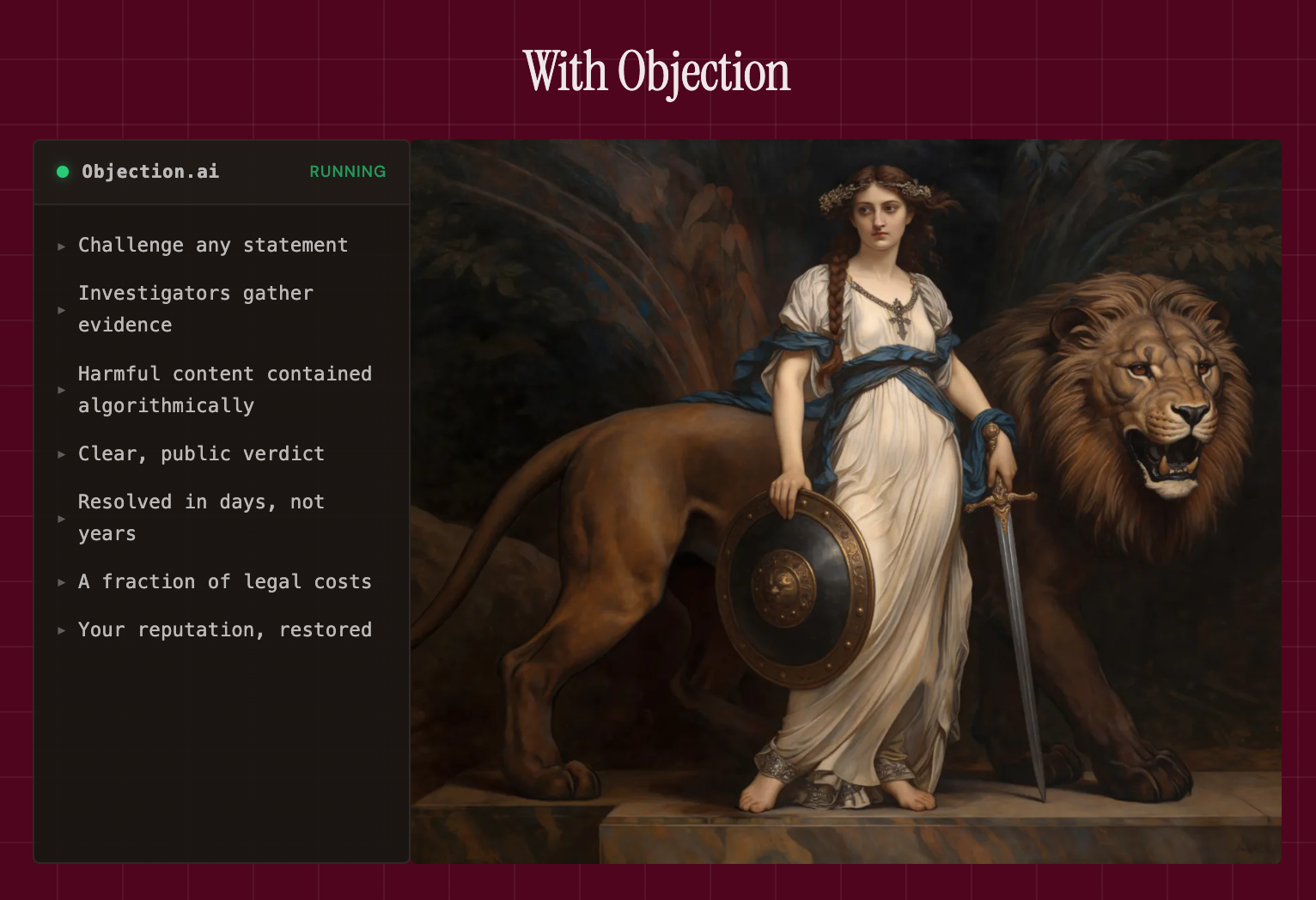
Objection.ai went live on April 15, 2026, with a clear operational model: any public member can flag a specific media claim for review. Professional investigators—drawn from former FBI, NSA, and CIA ranks—conduct adversarial evidence gathering, typically within three days. Subjects receive full opportunity to reply and submit counter-evidence. A panel of advanced reasoning models, guided by a custom Judicial-Purpose Transformer (JPT), then delivers a binary determination: the claim is true or not.
The full case file, including documents, communications, investigator findings, and rebuttals, becomes publicly accessible in a transparent data room. This structure differs from traditional litigation, which D’Souza notes often stretches 5–10 years and costs millions. Here, the timeline compresses to about 72 hours. Investigators can earn up to $10,000 per case, potentially creating a new revenue stream for rigorous fact-checking work.
D’Souza brings direct experience from high-profile accountability efforts. He led the legal strategy against Gawker that resulted in the outlet’s bankruptcy following Hulk Hogan’s privacy lawsuit, supported by Peter Thiel.
“Peter Thiel and I used the legal system to prove that journalists are not immune from accountability. The Gawker litigation took ten years and millions of dollars. Objection industrializes this process.”
“Only journalists can publish verdicts without due process. That ends today. A process that would take 5–10 years in court can now be completed in 72 hours.”
“Truth is no longer controlled by publishers. It is adjudicated. Now, because of advances in artificial intelligence reasoning, any dispute can be resolved without paying lawyers millions.”
The platform targets the asymmetry where media outlets issue public judgments on reputations, companies, or individuals with limited immediate recourse beyond costly lawsuits or prolonged social media disputes. Objection positions itself as infrastructure for verifiable truth assessment on the internet, focusing exclusively on empirical review of published claims rather than opinion or editorial stance.
Seed funding came from a multi-million-dollar round involving Peter Thiel, Balaji Srinivasan, Sarah Cone’s Social Impact Capital, and Max Samuel’s Off Piste Capital. No specific valuation or total raise figure was disclosed in the announcement. The company describes its approach as combining human expertise in investigation with scalable AI adjudication to maintain rigor while reducing time and expense.
For investors and operators tracking information integrity, the model introduces several practical considerations. It could lower the effective cost of challenging inaccurate reporting, potentially influencing how outlets approach sourcing and verification to avoid formal objections. At the same time, the AI tribunal’s output depends on the quality of underlying models and investigator inputs; any systematic bias in reasoning engines or selection of cases could affect perceived neutrality. Early usage patterns—volume of objections, acceptance rate of replies, and consistency of rulings—will determine whether the platform achieves durable credibility.
Objection does not replace courts or regulatory oversight. It operates as a parallel, faster evidentiary layer that produces public records usable in subsequent legal or reputational contexts. Pricing for raising objections was not detailed in the release, though investigator compensation suggests a fee-based or sponsored structure may apply.
The launch occurs amid broader debates on media trust, platform responsibility, and AI’s role in fact adjudication. D’Souza frames the effort as industrializing accountability that was previously accessible mainly to well-resourced parties. Whether it scales to influence mainstream reporting practices remains an open execution question.
New York-based platform, backed by Peter Thiel and Balaji Srinivasan, introduces a 72-hour evidentiary process combining human investigators and AI adjudication for contested journalism. Founder Aron D’Souza aims to address longstanding accountability gaps in media reporting.
Objection.ai went live on April 15, 2026, with a clear operational model: any public member can flag a specific media claim for review. Professional investigators—drawn from former FBI, NSA, and CIA ranks—conduct adversarial evidence gathering, typically within three days. Subjects receive full opportunity to reply and submit counter-evidence. A panel of advanced reasoning models, guided by a custom Judicial-Purpose Transformer (JPT), then delivers a binary determination: the claim is true or not.
The full case file, including documents, communications, investigator findings, and rebuttals, becomes publicly accessible in a transparent data room. This structure differs from traditional litigation, which D’Souza notes often stretches 5–10 years and costs millions. Here, the timeline compresses to about 72 hours. Investigators can earn up to $10,000 per case, potentially creating a new revenue stream for rigorous fact-checking work.
D’Souza brings direct experience from high-profile accountability efforts. He led the legal strategy against Gawker that resulted in the outlet’s bankruptcy following Hulk Hogan’s privacy lawsuit, supported by Peter Thiel.
“Peter Thiel and I used the legal system to prove that journalists are not immune from accountability. The Gawker litigation took ten years and millions of dollars. Objection industrializes this process.”
“Only journalists can publish verdicts without due process. That ends today. A process that would take 5–10 years in court can now be completed in 72 hours.”
“Truth is no longer controlled by publishers. It is adjudicated. Now, because of advances in artificial intelligence reasoning, any dispute can be resolved without paying lawyers millions.”
The platform targets the asymmetry where media outlets issue public judgments on reputations, companies, or individuals with limited immediate recourse beyond costly lawsuits or prolonged social media disputes. Objection positions itself as infrastructure for verifiable truth assessment on the internet, focusing exclusively on empirical review of published claims rather than opinion or editorial stance.
Seed funding came from a multi-million-dollar round involving Peter Thiel, Balaji Srinivasan, Sarah Cone’s Social Impact Capital, and Max Samuel’s Off Piste Capital. No specific valuation or total raise figure was disclosed in the announcement. The company describes its approach as combining human expertise in investigation with scalable AI adjudication to maintain rigor while reducing time and expense.
For investors and operators tracking information integrity, the model introduces several practical considerations. It could lower the effective cost of challenging inaccurate reporting, potentially influencing how outlets approach sourcing and verification to avoid formal objections. At the same time, the AI tribunal’s output depends on the quality of underlying models and investigator inputs; any systematic bias in reasoning engines or selection of cases could affect perceived neutrality. Early usage patterns—volume of objections, acceptance rate of replies, and consistency of rulings—will determine whether the platform achieves durable credibility.
Objection does not replace courts or regulatory oversight. It operates as a parallel, faster evidentiary layer that produces public records usable in subsequent legal or reputational contexts. Pricing for raising objections was not detailed in the release, though investigator compensation suggests a fee-based or sponsored structure may apply.
The launch occurs amid broader debates on media trust, platform responsibility, and AI’s role in fact adjudication. D’Souza frames the effort as industrializing accountability that was previously accessible mainly to well-resourced parties. Whether it scales to influence mainstream reporting practices remains an open execution question.