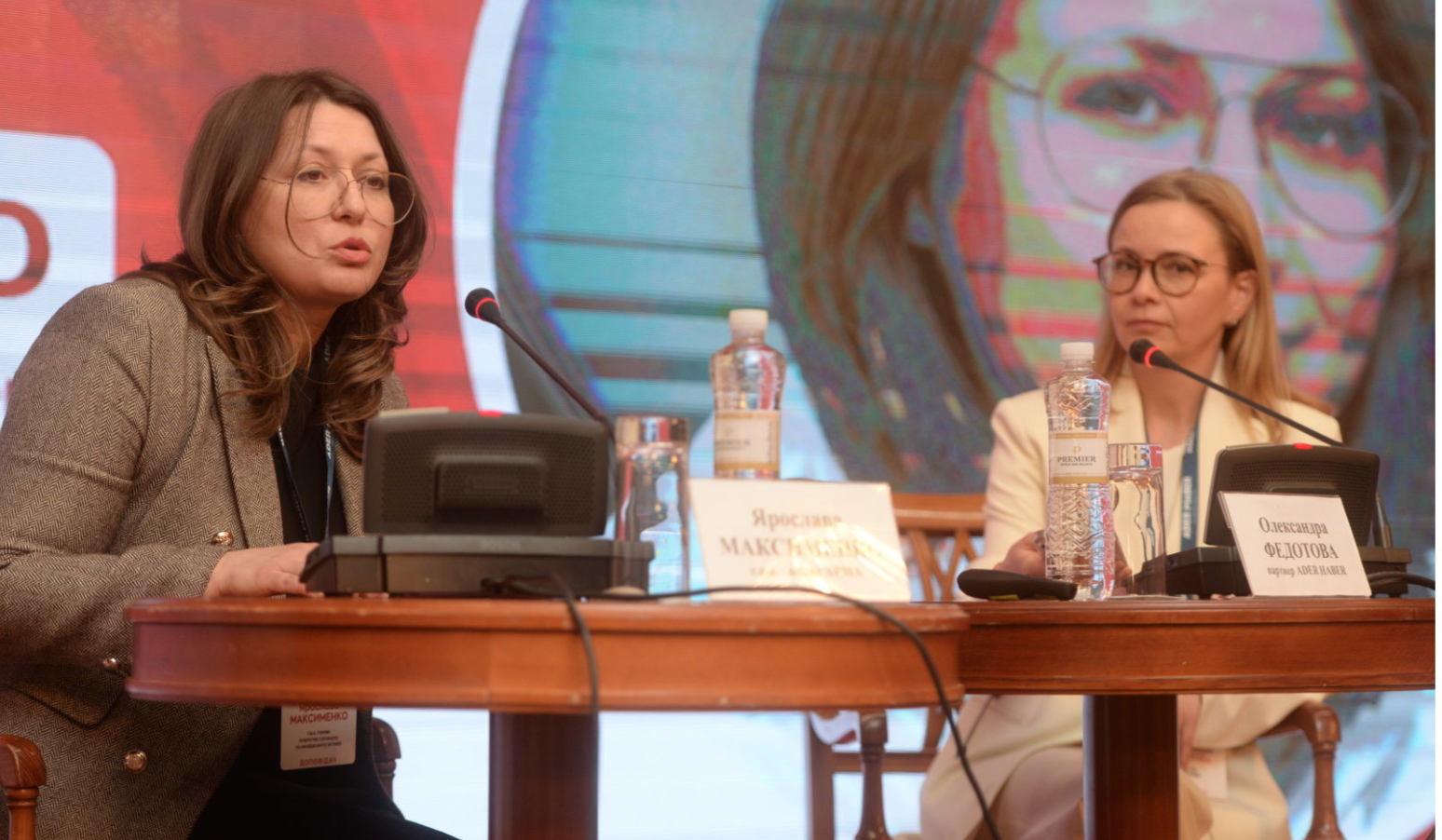
The Asset Hunter: How ARMA Is Turning Oligarchs' Empires Into Budget Revenue
Under acting head Yaroslava Maksymenko, Ukraine's Asset Recovery and Management Agency generated UAH 7.35 billion for the state budget in 2025 — and is now hunting oligarchs' property across three continents.
Most Ukrainians know the word arest — seizure — from criminal proceedings. But until recently, seizure meant something closer to a legal limbo: assets frozen by courts but neither managed nor generating income for the state, drifting in a bureaucratic void while their oligarch owners waited for windows of opportunity. That was the system Yaroslava Maksymenko inherited when she was appointed acting head of the Asset Recovery and Management Agency in August 2025.
What she walked into was a register containing over 102,000 entries — vehicles, apartments, mineral water plants, telecom shares, railway cars, and half-built mansions — accumulated across eight years of anti-corruption proceedings. Much of it untouched. Some of it lost. The rest requiring a level of systematic management Ukraine's anti-corruption infrastructure had never quite delivered.
The logic of seized asset management
ARMA's legal mandate is deceptively simple: find assets derived from corruption, trace them wherever they have been moved, and manage them so they generate value for the state rather than depreciating in storage. In practice, this means the agency sits at the intersection of criminal investigations, international sanctions enforcement, court orders, and commercial asset management — a combination of functions that no single institution had ever cleanly handled before.
The agency was created in 2017, but its performance over the following eight years was uneven at best. By the time Maksymenko arrived, it had accumulated an enormous portfolio of frozen assets while delivering inconsistent results on actual revenue generation. Transparency International Ukraine noted that the register had become "clogged" with household items and devalued properties alongside genuinely valuable commercial enterprises.
"We must ensure that every asset transferred to us works for the benefit of the state, enhances national defence, and delivers value to society."
The new ARMA reform law, which entered into force on July 31, 2025 — the same week as the Cardboard Revolution restored NABU's independence — formally restructured the agency. It introduced open competitive selection for ARMA's permanent leadership with international expert participation, strengthened the mechanisms for asset transfer to management, and launched a mandatory inventory of the entire portfolio. The timing was not coincidental: Ukraine's Western partners have consistently linked anti-corruption institutional capacity to both EU accession progress and continued budget support.
From Morshynska to Kyivstar: the oligarchs' assets in ARMA's portfolio
The most visible element of ARMA's work involves the assets of sanctioned Russian oligarchs — business empires built in Ukraine over three decades that cannot legally remain in the hands of individuals designated as threats to the Ukrainian state and international security.
The largest single cluster belongs to Mikhail Fridman, the Russian billionaire under sanctions from the US, EU, UK, Canada, Australia, and Ukraine. In November 2022, by court order, ARMA acquired management of the corporate rights, trademarks, and industrial designs of the entire IDS Ukraine group — the portfolio that includes Morshynska and Myrhorodska mineral water, two of Ukraine's most recognized consumer brands. In September 2024, the Ministry of Justice filed a lawsuit with the High Anti-Corruption Court seeking full confiscation of these assets in favor of the state.
Maksymenko has staked out a clear institutional position on these assets. When asked about the IDS Ukraine portfolio, she stated that seized assets linked to sanctioned individuals cannot simply sit idle — the law requires active management to prevent financial flows from being withdrawn uncontrolled and to avoid value destruction. ARMA launched a new tender through the Prozorro system in November 2025, with conditions published in advance and criteria identical for all participants.
Hunting assets across three continents
The international dimension of ARMA's work has quietly become one of its most consequential functions. In 2025, the agency processed nearly 9,500 cross-border tracing requests in coordination with law enforcement agencies and international asset recovery organizations.
- United States: Real estate belonging to a Ukrainian official's family valued at $3.2 million; a second official's property valued at approximately $500,000
- Spain: Shares in companies of a sanctioned politician worth over EUR 4 million; a second estate discovered in the same jurisdiction
- Montenegro: 12 properties belonging to an official accused by the State Council, valued at EUR 12.9 million
- France: A politician's estate — including a car and multiple apartments — valued at EUR 11 million
This international work runs in permanent coordination with NABU, SAPO, the SBU, and the Economic Security Bureau (ESBU). The significance of the July 2025 Cardboard Revolution is legible here: had Bill 12414 remained law and the Prosecutor General acquired control over NABU's investigative pipeline, the requests feeding ARMA's international tracing work would have passed through a presidential appointee before reaching partner jurisdictions abroad. The institutional links between Ukraine's domestic anti-corruption architecture and its international asset recovery capacity are structural, not incidental.
The profile: Yaroslava Maksymenko
Maksymenko's appointment at ARMA comes with complications the index reflects. Her CRI score of 440 places her in the Low band — meaning there is no significant documented corruption risk — but the score also captures a set of contested questions that surround her tenure. A Kyiv utility filed a lawsuit against her and her husband in March 2026 for alleged debt arrears. Questions have been raised about a Crimea-registered company linked to her family that remained in a legally ambiguous status long after 2014. A court also ordered the State Bureau of Investigation to open proceedings related to ARMA's failure to return seized property to an owner after a court order. Transparency International Ukraine noted that while her presentations to parliament showed more focus on constructive reform than her predecessor, the agency still could not produce documentary evidence for some inventory claims.
None of this constitutes a finding of wrongdoing. But for an institution whose entire purpose is accountability, the acting head's own transparency record matters as a signal.
The reform architecture: what changed in 2025
The budget logic: why this matters beyond anti-corruption
For American policymakers and investors tracking Ukraine's recovery trajectory, ARMA's function carries a specific kind of importance that goes beyond its role as an accountability mechanism. In 2025, the agency generated UAH 7.35 billion in state budget revenue at an operating cost of UAH 316 million — meaning it returned roughly 23 hryvnias for every one spent on its own maintenance. Its portfolio of military government bonds held in seized asset accounts amounts to UAH 4.5 billion.
These are not symbolic numbers in a country financing a war almost entirely on external assistance. The OECD's Anti-Corruption Unit stated explicitly in July 2025 that undermining NABU and SAPO — the agencies whose investigations feed ARMA's seizure pipeline — would damage credibility among partners "considering investing in Ukraine's defense sector and its long-term reconstruction." That statement was made in the context of Bill 12414. It applies equally to ARMA: every seized asset that deteriorates unmanaged, every confiscation proceeding that drags for years, and every international discovery that goes unfollowed is money not entering the budget that pays for the war.
What the CRI captures about ARMA's place in the system
The Ukraine Corruption Risk Index scores Yaroslava Maksymenko at 440 — the Low band. This reflects the absence of any significant documented corruption findings, a reform-oriented track record, and a professional biography built around transparency mechanisms. It also reflects the contested questions that have emerged since her appointment, which the index treats as open rather than resolved. The permanent competition is ongoing; a more definitive picture of ARMA's institutional trajectory will come with whoever holds the role following that process.
What the index cannot fully capture is the systemic significance of ARMA's position in Ukraine's anti-corruption architecture. NABU investigates. SAPO prosecutes. HACC adjudicates. ARMA manages what survives that chain. If any link breaks — as nearly happened in July 2025 — the others are weakened downstream. The Cardboard Revolution defended two of those links directly. The question of whether ARMA will function as the fourth, equally robust link remains open as of April 2026.
For the July 2025 Cardboard Revolution analysis, see: The Cardboard Revolution: How Ukraine's Streets Defended Its Anti-Corruption Architecture — Smart Times, July 2025.
Sources: ARMA official press releases (arma.gov.ua); Interfax-Ukraine interview with Yaroslava Maksymenko, March 2026; Transparency International Ukraine — "ARMA on the Road to Reform," March 2026; RFE/RL Schemes investigation; New Voice of Ukraine; UNN; AntKor portal; ARMA reform law (entered force July 31, 2025). All CRI scores current as of April 2026. No score constitutes a legal finding.