Special Report · Anti-Corruption & AI
Palantir Helps Unearth Corruption
in London's Metropolitan Police
In a week-long covert AI pilot, Palantir's data intelligence tools exposed hundreds of rogue officers inside Britain's largest force — and signaled, with striking clarity, why the same technology is essential to the fight against corruption in Ukraine.
The Metropolitan Police — one of the world's most storied law enforcement institutions, with 46,000 officers and staff — had a corruption problem it could not see. Seniority and insider knowledge had long made it possible for officers to abuse HR systems, file false overtime claims, hide their Freemason affiliations, and exploit their authority for sexual and financial gain, all beneath the radar of conventional oversight. What finally exposed them was not a whistleblower, not a parliamentary inquiry, and not a decade-long criminal investigation. It was a week. One week of AI-powered data analysis by Palantir Technologies — and Scotland Yard will never look at its own personnel records the same way again.
The results, reported by The Guardian and confirmed by the Metropolitan Police Service on April 25, 2026, were staggering. Hundreds of officers face disciplinary proceedings. Three have been arrested. Two are suspended. Twelve are under formal gross misconduct investigation for concealing Freemason membership. Ninety-eight were flagged for systematic abuse of duty rostering. A further thirty remain under active suspicion for behaviours that, prior to the pilot, existed in scattered datasets invisible to any single analyst.
How Palantir's Technology Works
Palantir was founded in 2003 by Peter Thiel, Alex Karp, and a small team of engineers with a singular mission: to make sense of vast, fragmented datasets that human analysts simply could not process at scale. Its two flagship platforms — Gotham, built for government and defense intelligence, and Foundry, designed for enterprise data integration — share a common architecture. They pull together existing data from disparate sources, apply machine learning algorithms to detect anomalies and behavioral patterns, and surface actionable intelligence through a visual interface that does not require an analyst to be a data scientist.
In the Metropolitan Police pilot, the technology worked by ingesting internal HR records, building access logs, overtime claims, expenses, sickness records, and public complaints — data that already existed inside the Met's own systems but had never been analyzed holistically. The AI did not invent new surveillance. It simply connected the dots that human investigators never had the bandwidth to connect. In seven days, it produced a map of institutional misconduct that years of conventional oversight had missed entirely.
Commissioner Sir Mark Rowley, describing the programme's rationale, stated that the Met was committed to using "technology, data and stronger legal powers to confront poor behaviour." Crucially, he emphasized that the system does not create new surveillance — it organizes information the force already holds lawfully, and identifies risk earlier than any human-led process could achieve. He is now considering expanding Palantir's remit to criminal investigations: analysing crime data, identifying high-risk offenders, and flagging dangerous predators before they strike again.
The Police Federation, representing rank-and-file officers, pushed back sharply, calling the approach "automated suspicion" and warning that officers "must not be subjected to opaque or untested tools that risk misinterpreting unsustainable workload pressures." The tension between institutional accountability and civil liberties concerns is real — but it is notable that the Met pilot did not generate false positives that ended innocent careers. It found a mass of genuine misconduct, from officers sexually harassing colleagues to senior staff hiding Freemason affiliations that represented direct conflicts of interest with active criminal cases.
"This is the Met using technology, data and stronger legal powers to confront poor behaviour. The vast majority of our officers and staff serve London with dedication and integrity — and rightly expect us to act firmly against those who abuse their position or undermine public trust."
What Was Found: The Corruption Taxonomy
The breadth of misconduct uncovered in a single week speaks not only to Palantir's capabilities but to the depth of the institutional problem. The findings span six distinct categories of wrongdoing, ranging from financial fraud to sexual predation.
| Category | Nature of Misconduct | Severity |
|---|---|---|
| Financial Fraud | False overtime claims; HR system manipulation for extra pay and days off | High |
| Authority Abuse | Abuse of position for sexual purposes; sexual harassment of colleagues | Critical |
| Deception | Lying about working from home; falsified location and activity records | High |
| Non-Disclosure | Concealing Freemason membership — a direct conflict of interest in active cases | High |
| Criminal Conduct | Sexual assault; serious corruption warranting arrest | Critical |
| Suspicious Behaviour | 30 officers flagged; behaviour currently uncorroborated but under review | Developing |
MPs reacted with alarm — not only at the scale of misconduct but at Palantir's expanding footprint in British public institutions. The company's UK public-sector contracts now exceed £500 million, spanning the NHS (including a £330 million patient data deal under parliamentary pressure), the Ministry of Defence (a £240 million contract signed after Peter Mandelson accompanied Prime Minister Keir Starmer to Palantir's Washington showroom), eleven smaller police forces, and now the Met. A Met intelligence analysis contract, if approved, would represent a significant further expansion. Some MPs this week called for a government review of all Palantir contracts, describing a company manifesto the firm published on X as "the ramblings of a super villain." No formal review has been ordered.
The Trump Orbit: Thiel, Karp, and the New Washington
Palantir's political positioning in 2026 is inseparable from its business trajectory. The company was co-founded by Peter Thiel — billionaire, libertarian ideologue, and one of Donald Trump's most consequential early backers. Thiel put $1.5 million into pro-Trump groups in 2016, vouched for the candidate at the Republican National Convention, and joined Trump's transition team that year. His most significant political investment may be JD Vance, whom Thiel mentored, employed, introduced to Trump, and bankrolled with a reported $15 million in his 2022 Senate campaign before Vance's ascent to the Vice Presidency.
CEO Alex Karp describes himself as a "progressive warrior" who supported Kamala Harris in 2024 — a political contrast to Thiel. But where the two men converge is around a shared conviction that Palantir's technology should, as Karp has put it, "power the West to its obvious, innate superiority." Under Trump's second term, that convergence has translated into a cascade of federal contracts worth over $1.3 billion across Defense, Homeland Security, Treasury, State, Health and Human Services, and a dozen other agencies. Palantir's stock has surged over 200% since Trump's election. The company also holds a $30 million ICE contract for near-real-time tracking of immigrants, and a $1 billion DHS contract signed in February 2026.
"Having political connections and inroads with Peter Thiel and Elon Musk certainly helps them. It makes deals come faster without a lot of negotiation and pressure."
Thiel's influence over the current administration operates primarily through a network of allies, former employees, and investment beneficiaries embedded across the executive branch — including the Vice President, DOGE co-leader Elon Musk, and the CIO of the Department of Health and Human Services, a former Palantir engineer. Thiel himself holds no formal role. He does not need one.
Trump Jr., Musk, and the Ukraine Corruption Narrative
While Palantir works with the Trump administration and its allies to deploy AI for anti-corruption and law enforcement purposes, the same orbit has been vocal — and pointed — about what it perceives as endemic corruption inside Ukraine.
At the Doha Forum in December 2025, Donald Trump Jr. delivered remarks that framed Ukraine's corruption not as a marginal problem but as a defining feature of the Zelensky era that Western governments had willfully ignored. He stated that prior to the war, Ukraine ranked as a more corrupt country than Russia according to US government assessments, and that Zelensky's (CRI 610 Elevated) skill as a communicator had insulated him from the scrutiny that would normally attach to a head of state presiding over documented graft. "He was beyond criticism," Trump Jr. said, "and the years-long corruption, bribery, and theft on the world stage, which everyone in this room knew about, were fully justified."
Elon Musk, for his part, posted on X in February 2025, following the dramatic Oval Office confrontation between Trump and Zelensky: "Time to find out what really happened to the hundreds of billions of dollars sent to Ukraine." DOGE, according to a senior US official cited by Reuters, was already examining potential problems with US aid disbursements to Ukraine — and those efforts accelerated following the clash. Ukraine's own anti-corruption agencies had, by that point, already announced "Operation Midas" — a 15-month investigation involving roughly 1,000 hours of wiretaps that uncovered a $100 million kickback scheme inside the state-owned nuclear company Energoatom, allegedly linked to Timur Mindich (CRI 830 Critical), a longtime associate of Zelensky. Press reporting on the investigation also drew scrutiny toward Rustem Umerov (CRI 580 Elevated), then serving as Defense Minister, though no formal charges against him have been filed.
"Time to find out what really happened to the hundreds of billions of dollars sent to Ukraine."
Karp in Kyiv: The Bunker Meeting That Started It All
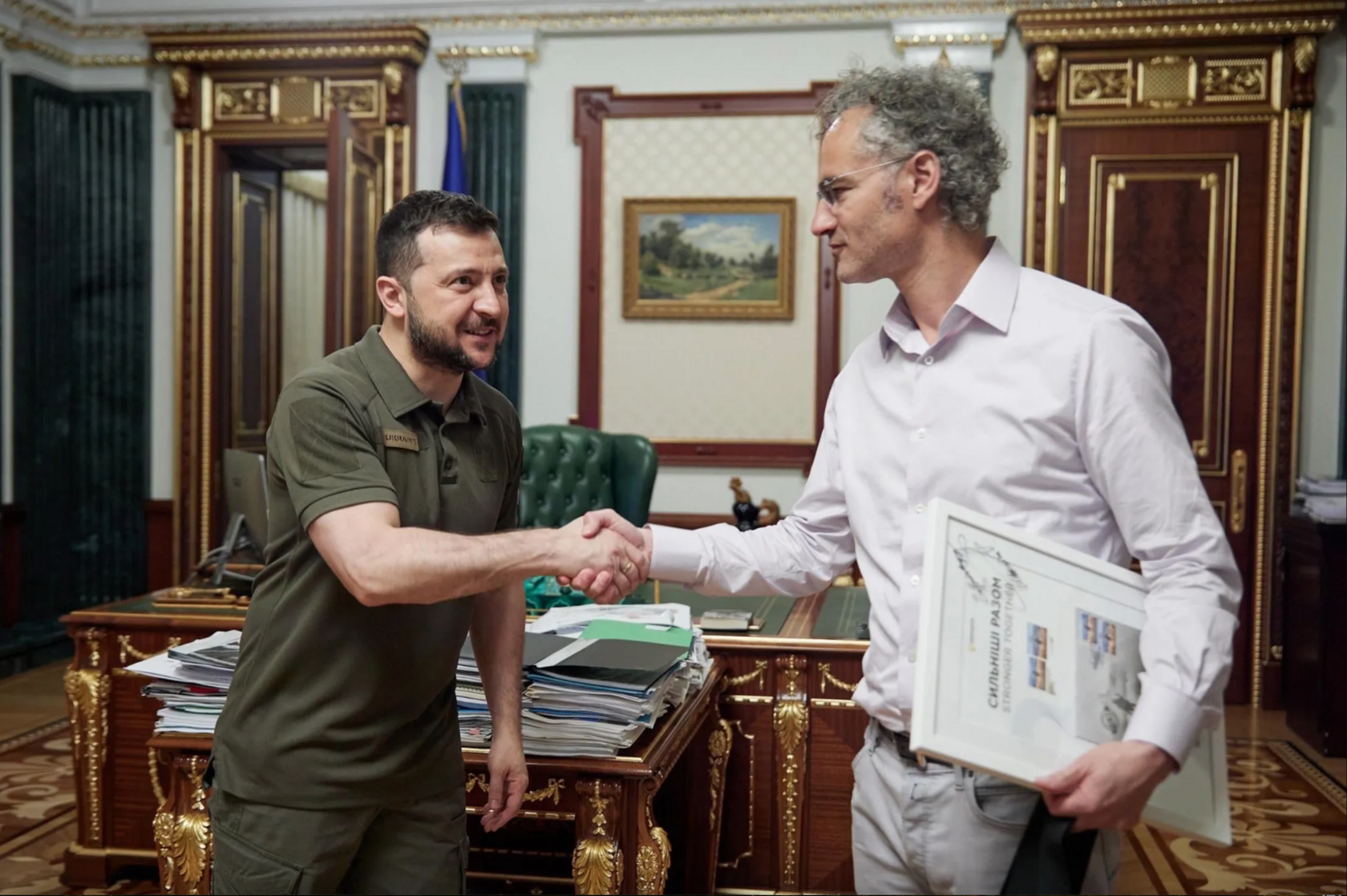
On June 1, 2022, Alex Karp crossed the Polish-Ukrainian border on foot with five colleagues, traveling in secret to a country three months into a full-scale war. The following day, he was escorted into the fortified bunker beneath the presidential palace on Bankova Street in Kyiv — becoming, as Ukrainian Vice Prime Minister Mykhailo Fedorov (CRI 410 Low) confirmed in a tweet, "the first CEO who came to Kyiv after the start of the full-scale war."
Over espressos in the presidential bunker, Karp told Zelensky he was ready to open a Palantir office in Kyiv and deploy the company's data and AI capabilities in direct support of Ukraine's defense. The meeting produced an agreement in principle: a Palantir office in Ukraine, digital support for the Ukrainian army, and a commitment to what Karp would later describe as Palantir's mission to "defend the West" and to "scare the f-ck out of our enemies."
What struck observers about the encounter was the incongruity of the setting and the characters. Zelensky (CRI 610 Elevated) — a former comedian and television producer who had played a fictional president on Ukrainian TV before winning a real election in 2019 — was, by the time Karp arrived, already conducting his presidency from a wartime bunker, living on sweets and tinned meat, separated from his family, sleeping in a room that smelled of gun oil. He had, according to Time journalist Simon Shuster's embedded account, become "almost unrecognizable" from the easy-going entertainer he had been before the invasion: "There's just a toughness and a certain darkness about him now that really didn't exist before." Karp, famously idiosyncratic and given to philosophical tangents, encountered not the comedian his briefing materials may have described, but a hardened wartime commander who had already chosen to stay in Kyiv when most of his cabinet had fled.
Karp told Time magazine's correspondents that he was moved by what he saw — and surprised by the nature of the man he met. Zelensky's background as a comedian had led many Western observers to underestimate him. His conduct in the bunker was not comic. It was, by multiple accounts, gravely serious, strategically acute, and emotionally controlled in a manner that impressed a man not easily impressed. "Zelenskyy has shown the world," as the Russian-born American novelist Gary Shteyngart put it at the time, "that Jewish comedians are not to be trifled with. Beneath all the laughs they have a backbone of steel."
"In Ukraine, Karp saw the opportunity to fulfil Palantir's mission to 'defend the West' — and to 'scare the f-ck out of our enemies.'"
Since that June 2022 meeting, Palantir has embedded itself deeply in Ukraine's operational and governmental infrastructure. Palantir operatives have worked directly with Ukrainian military units. The company's AI and data platforms have been applied to battlefield targeting, logistics, and intelligence analysis. Ukraine, in Palantir's own framing, became a live theater for the most consequential deployment of commercial AI in the history of armed conflict — a laboratory that has informed its subsequent contracts with the US Defense Department, NATO allies, and now, in a different key, the Metropolitan Police.
Consequences for Ukraine: Why the Met Pilot Matters
The London Metropolitan Police case is not, at first glance, a Ukraine story. But for anyone tracking the intersection of AI, anti-corruption enforcement, and US political dynamics, the implications are direct and consequential.
The Ukraine CRI at smarttimes.net/corruption-score/ukraine applies the same analytical logic as the Palantir Met pilot: pulling together press mentions, legal records, sanctions data, procurement anomalies, asset declarations, and behavioral pattern recognition to score over 100 Ukrainian politically exposed persons (PEPs) on a 0–1,000 corruption risk scale. The methodology mirrors what Palantir demonstrated in London — connecting fragmented data that exists in the public domain but has never been synthesized at scale.
The Met pilot proves the model works in law enforcement at institutional scale. Ukraine, which receives more US aid than any country in a generation, faces a version of the same challenge: identifying who is actually corrupt, how severely, and in what direction their risk profile is moving — before Western capitals make disbursement decisions that cannot be undone.
The political stakes are acute. The Trump administration has made Ukraine's corruption a consistent theme, with DOGE examining aid flows, Trump Jr. making extended public statements about institutional graft, and Musk demanding accountability for hundreds of billions in disbursements. That pressure is not without foundation — Ukraine's own NABU and SAPO agencies have launched major prosecutions, including Operation Midas, and the July 2025 attempt by the Verkhovna Rada to subordinate NABU and SAPO to presidential control triggered a European aid freeze and street protests before being reversed nine days later. The CRI had already flagged key figures in that episode in its High and Elevated risk bands before the crisis became public.
What Palantir demonstrated in London is that AI-driven corruption detection is not theoretical, not speculative, and not limited to authoritarian surveillance states. In a mature democracy with strong civil liberties traditions, a week of data analysis inside an institution's own records produced actionable evidence of serious criminal conduct. The same class of technology, applied to Ukraine's procurement systems, asset declarations, court filings, and corporate registries, is what powers the Ukraine Corruption Risk Index — and what gives the international community its first real-time instrument for tracking the governance risk of the individuals controlling one of the largest aid recipients in modern history.
The political stakes are compounded by money — enormous amounts of it. The US-Ukraine Reconstruction Investment Fund, established by the minerals deal signed on April 30, 2025, is fully operational as of late 2025 and poised to begin its first investments in 2026. The Fund prioritizes critical minerals, energy, transport and logistics, information and communications technology, and emerging technology, with the explicit goal of mobilizing US and US-aligned private capital. The US International Development Finance Corporation has already committed a $75 million seed investment in critical minerals and strategic sectors in Ukraine, mobilizing an additional $75 million in non-US government co-funding. The scale of private capital now queuing behind those government anchors runs into the hundreds of billions.
Palantir, PEPs, and the Investment Due Diligence Imperative
American experts and policy analysts with knowledge of Palantir's Ukraine operations believe the company is now actively engaged in something that goes well beyond battlefield AI and demining algorithms: the systematic vetting of Ukrainian politically exposed persons — PEPs — in the context of US-Ukraine commercial deals, reconstruction investment, and the governance conditions that American capital requires before it will deploy at scale.
The logic is straightforward. On April 24, 2026 — the day before the Metropolitan Police story broke — Ukraine's Deputy Prime Minister for Reconstruction, Oleksiy Kuleba (CRI 460 Moderate), announced the signing of a memorandum of cooperation between his ministry and Palantir Technologies. Palantir will be involved in analyzing solutions for infrastructure development and reconstruction in various regions of Ukraine, beginning with a pilot project in two regions that will then scale to the entire territory of Ukraine, and will develop an AI-supported system for assessing the resilience of regions. This is Palantir's fourth formal Ukraine government engagement, following its 2022 defense partnership, its 2023 reconstruction deal with the Ministry of Digital Transformation, and its 2024 AI demining agreement with the Ministry of Economy.
Each new contract layer deepens Palantir's access to Ukrainian governmental data — regional procurement records, infrastructure project pipelines, state-owned enterprise financials, and the network of officials who control them. That data, processed through Palantir's Foundry platform, produces exactly the kind of PEP behavioral profile that international investors and US government due diligence teams require before committing capital to projects in a high-corruption-risk environment. American analysts tracking Palantir's Ukraine footprint note that the company is uniquely positioned to answer the question that every serious investor in the reconstruction fund is privately asking: who, among the Ukrainian officials and state-enterprise managers controlling asset allocation, can actually be trusted with American money?
The US-Ukraine Reconstruction Investment Fund — signed April 30, 2025, fully operational December 2025 — targets critical minerals, energy, maritime infrastructure, and technology. The DFC has committed $75M in seed capital, mobilizing $75M more in co-funding, with hundreds of billions in private capital queuing behind.
Corruption remains the primary deterrent to foreign direct investment in Ukraine. State-owned enterprises like oil producer Ukrnafta operate without independent supervisory boards, and the lack of reliable governance data, outdated infrastructure, and corruption risks deters foreign investment. Reconstruction deals that bypass individual PEP vetting carry material legal and reputational exposure for US investors under FCPA, AML, and sanctions frameworks.
Ukraine joined the OECD Anti-Bribery Convention in 2025, raising the standard for investors to a "Zero Tolerance" threshold, requiring forensic mapping of ownership chains beyond simple registry checks, to ensure no links to sanctioned entities. That obligation makes systematic AI-driven PEP analysis not a luxury but a legal necessity.
RAND Corporation, whose data are used in the Smart Times anti-corruption research framework and who has produced extensive analysis of Ukraine's reconstruction economics, published a January 2026 assessment concluding that when the fighting stops, the most promising opportunities for US companies will be in Ukraine, not Russia — but qualified that conclusion with a frank accounting of governance obstacles. RAND's Europe team, in a concurrent analysis of Ukraine's defense-industrial base and foreign investment landscape, identified perceptions of corruption, bureaucracy, and unclear procurement processes as practical barriers deterring increased investment in Ukraine's strategic sectors. The implication is direct: governance transparency is not a secondary concern for investors — it is the primary gating condition.
Transparency International's 2025 Corruption Perceptions Index, published February 2026, scored Ukraine 36 out of 100 — an improvement over prior years, but still placing it in the bottom half of global rankings and well below the threshold that triggers automatic investment-grade comfort from institutional allocators. In Ukraine, sustained pressure from NGOs, the public, and journalists has helped drive governance reforms, and the specialised anti-corruption system has increased investigations and secured convictions in politically sensitive procurement and defense cases. The progress is real. So is the remaining risk. The TI score does not tell an American pension fund manager or a private equity partner which specific individuals controlling a given concession, ministry, or state enterprise are safe counterparties — and which are not.
That granular, individual-level intelligence is precisely what Palantir's data architecture is designed to produce, and what the Ukraine Corruption Risk Index replicates through open-source analytical methods. The CRI scores over 100 Ukrainian PEPs on a 0–1,000 scale, drawing on formal legal records, sanctions monitoring, AI press analysis, procurement anomaly detection, and asset declaration cross-referencing — the same analytical pillars that underpin Palantir's institutional deployments. For the American investor entering Ukraine's reconstruction market in 2026, that score is not an academic exercise. It is the difference between a sound deal and a FCPA violation, a profitable infrastructure concession and a headline risk that ends careers.
"When the fighting stops, the most promising opportunities for U.S. companies won't be in Russia, but in Ukraine."
Palantir's expanding footprint — from Kyiv's war rooms to London's police headquarters to Washington's immigration enforcement apparatus, and now to Ukraine's regional reconstruction pipeline — tells a coherent story about where the technology is going and who controls its deployment. Peter Thiel built a company to see what governments cannot see on their own. Alex Karp has spent two decades persuading those governments to pay for that vision. In a single week in London, that vision produced 100 misconduct cases, three arrests, and a blueprint that the world's anti-corruption establishment would do well to study — and replicate. In Ukraine in 2026, the same vision is being applied to something with even larger stakes: deciding, with the precision of a credit bureau, who gets to participate in the reconstruction of a country, and who does not.
Smart Times · April 25, 2026
Anti-Corruption & AI Special Report
CRI Version 5 in effect · Version 6 publishes May 2026
General inquiries:
info@smarttimes.net
The Guardian · LBC · City AM · NPR · Bloomberg
Presidential Office of Ukraine · Palantir Technologies
Metropolitan Police Service · Time Magazine
Fox News · FactCheck.org · Newsweek